At a Glance
- Darin Cunningham recently represented buyers in three Middle Tennessee land purchases of about $8.5 million, $6 million and $4 million, roughly $18.5 million in land before a single home is built.
- Bloomberg’s October 2026 analysis of Realtor.com data found Nashville-area sales in the nation’s top 1% price tier (about $3 million+) tripled between 2017 and 2025.
- IRS migration data show Tennessee gained about 24,104 net income tax filers and roughly $2.8 billion in net adjusted gross income from other states in 2022 to 2023, fifth nationally.
- Buyers are seeking 20 to 100+ acres in Williamson County and the surrounding countryside for multigenerational compounds, guesthouses and collector-car facilities holding 20 to 60 vehicles.
- Zoning, septic capacity, topography, access and development feasibility decide whether a tract can become an estate, which makes the land purchase the most consequential decision.
- Confidentiality is treated as an amenity: coordinated showings, limited disclosure and off-market acquisitions protect high-profile buyers.
Nashville has been attracting wealthy residents for years. But something different is happening at the very top of the real estate market.
I am seeing buyers who are not simply relocating to purchase a luxury home. They are acquiring substantial acreage and creating private estates designed around their families, businesses, collections and long-term lifestyles.
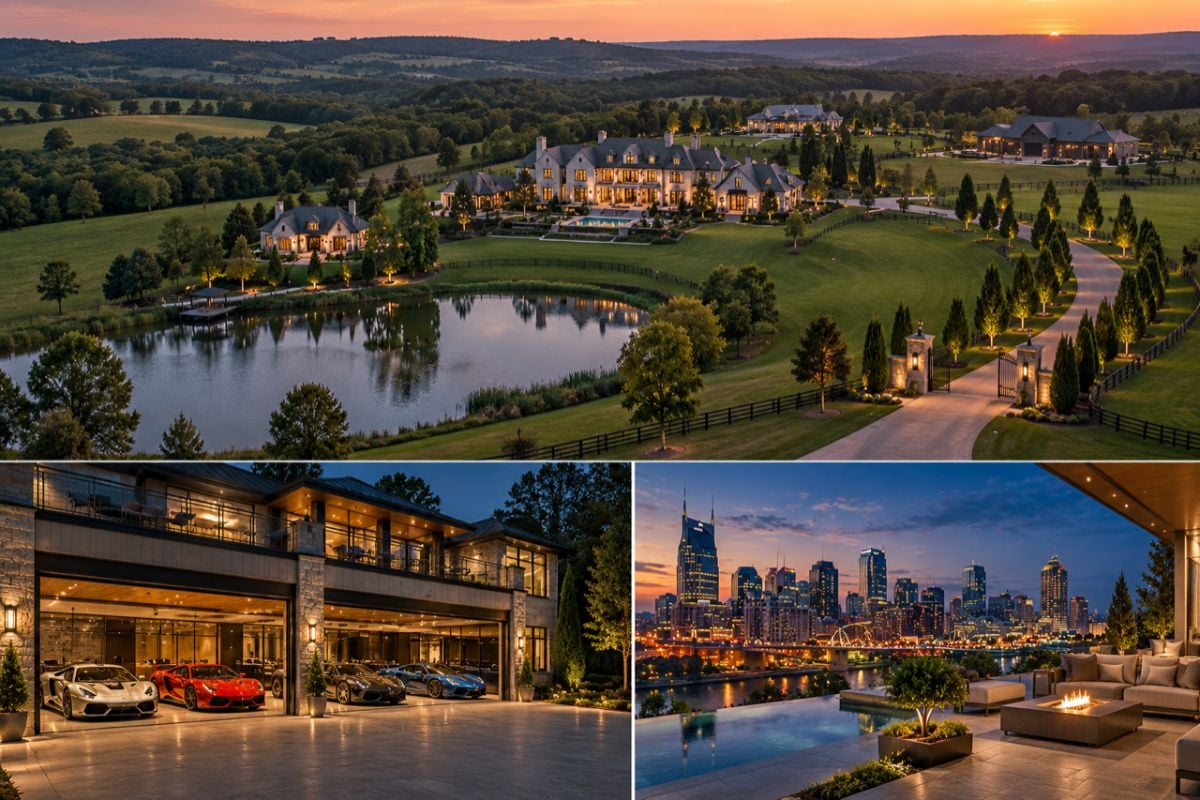
Some of these properties will include multiple residences, guesthouses, recreational facilities and garages capable of housing dozens of collectible automobiles.
And the land alone can cost millions.
I have recently represented buyers in three separate land transactions involving approximately $8.5 million, $6 million and $4 million, respectively. That is $18.5 million in land purchases before a single home is built.
These are not speculative subdivisions or traditional luxury home purchases. The buyers intend to create private estates.
I cannot identify the clients, and I will not disclose details that could compromise their privacy. But I can discuss what these transactions tell me about the direction of Nashville’s luxury real estate market.
The wealth arriving in Middle Tennessee is changing what buyers want, where they want to live and what they are willing to spend to create it.
Bloomberg Is Paying Attention to Nashville’s Wealth Migration
In October 2026, Bloomberg examined the influx of ultrawealthy residents into the Nashville region as part of a broader migration of wealth toward the American South.
The report focused particularly on the areas south of Nashville, where buyers can find a combination of land, privacy and proximity to the city’s amenities.
One of the most significant findings was the growth in transactions at the very top of the housing market.
According to Bloomberg’s analysis of Realtor.com data, the number of Nashville metropolitan area homes selling within the nation’s top 1% of home prices, approximately $3 million or more in 2025, tripled between 2017 and 2025.
Bloomberg also reported that before the pandemic, approximately $2.8 million was enough to enter the top tier of Nashville’s housing market, roughly 40% below the national threshold. That pricing gap has since disappeared.
Those are meaningful changes.
They suggest Nashville is no longer simply an affordable alternative to established luxury markets. At the upper end, it is increasingly competing for buyers with substantial purchasing power.
I see the same trend in my own business.
The difference is that some of the transactions I am involved with never begin as a search for an existing home.
They begin with a search for land.
$18.5 Million in Land Purchases Before Construction Even Begins
Consider three transactions I have recently completed for clients.
One involved an approximately $8.5 million land purchase.
Another involved approximately $6 million.
The third involved approximately $4 million.
All three buyers intend to build private residences on their properties.
When someone spends $8.5 million on land before beginning construction, they are making a very different real estate decision from someone purchasing an existing $8.5 million home.
They are buying the ability to create something highly customized.
That may include a main residence, guest accommodations, separate structures for family members, extensive outdoor amenities and facilities that support their personal interests.
Some buyers want room for extended family to visit for weeks at a time.
Others want a property where multiple generations can spend time together while maintaining their own private spaces.
For some, the property becomes a place to accommodate their automobile collection, recreational interests or business-related needs.
The common denominator is control.
They want to control the architecture, the setting, the privacy and how the property functions.
They are not simply buying a house. They are creating an environment around their lifestyle.
The Numbers Behind Tennessee’s Wealth Migration
The broader migration data help explain why these transactions are becoming more common.
According to an analysis of IRS migration data, Tennessee gained approximately 24,104 net income tax filers from other states between 2022 and 2023.
Tennessee ranked fifth nationally for net gains in interstate income tax filers during that period, behind Texas, Florida, North Carolina and South Carolina.
The movement involved substantial income as well.
An analysis of the same IRS data found that Tennessee gained approximately $2.8 billion in net annual adjusted gross income through interstate migration.
That does not mean $2.8 billion in cash was transferred into Tennessee bank accounts. It means the annual income associated with taxpayers moving into Tennessee exceeded the income associated with those moving out by approximately that amount.
The distinction matters, but the economic implications are still significant.
When households with substantial income relocate, their housing decisions can affect the local real estate market, particularly in areas with limited land availability.
The Nashville region is also continuing to grow.
According to Census Bureau figures reported in April 2026, Davidson County added approximately 9,300 residents in 2025, the largest numerical increase among Tennessee counties. Rutherford, Wilson, Williamson and Sumner counties were also among the state’s ten fastest-growing counties by population increase.
Not all of those new residents are wealthy, of course.
But the data establish a broader pattern: Nashville and its surrounding counties continue to attract people, income and investment.
Why the Wealthiest Buyers Are Looking Beyond Nashville’s City Limits
When people hear about luxury real estate in Nashville, they often think of Belle Meade, Green Hills, Forest Hills or the established luxury neighborhoods within Davidson County.
Those markets remain important.
But for buyers seeking significant acreage, the search frequently extends into Williamson County and the surrounding Middle Tennessee countryside.
Brentwood, Franklin, Arrington, Thompson’s Station and nearby rural areas can offer opportunities that are difficult to replicate closer to downtown Nashville.
A buyer might want 20 acres.
Another might want 50 acres.
Some are searching for 100 acres or more.
At that scale, the property becomes as important as the house.
Buyers are evaluating topography, views, access, privacy, neighboring land uses, development restrictions and whether the property can accommodate multiple structures.
A beautiful tract of land is not necessarily a suitable estate site.
That is why understanding zoning, soils, utilities, access, drainage and development feasibility becomes especially important at this level.
The land acquisition itself can be one of the most consequential decisions in the entire project.
The Rise of the Private Family Compound
One of the most interesting changes I am seeing is the desire to build properties that accommodate more than one household or generation.
The traditional luxury home might have included six bedrooms, a pool and a large entertaining area.
The estates being contemplated today can be considerably more complex.
A buyer may want a primary residence, a separate guesthouse, accommodations for extended family, recreational facilities and additional structures for hobbies or property operations.
These arrangements require thoughtful planning.
Not every property allows multiple residences. Zoning, septic capacity, building restrictions, easements and local regulations can affect what is permitted.
But when the land and regulations support the intended use, the result can be something very different from a conventional luxury home.
It becomes a private family compound.
For buyers with substantial wealth, that flexibility may be more valuable than purchasing an existing mansion in a traditional neighborhood.
When the Garage Becomes a Major Part of the Estate
I have also seen growing interest in estates designed around serious automobile collections.
I am not talking about a four-car garage.
Some buyers envision facilities capable of accommodating 20, 40 or even 60 vehicles.
For collectors of Ferraris, Lamborghinis, Bugattis, Paganis and other rare automobiles, the garage may be a major architectural component of the property.
These structures can require specialized lighting, climate control, security, vehicle lifts, storage systems and carefully designed access.
Some buyers also envision living quarters or apartments associated with the facility, subject to applicable zoning and building requirements.
The purpose is not necessarily to display wealth.
For a serious collector, the vehicles are a passion. The property needs to accommodate that passion properly.
And when a buyer can acquire enough acreage, the automobile facility can be designed as part of the overall estate rather than squeezed into an existing residential setting.
Privacy Is One of the Most Valuable Amenities
The higher the profile of the buyer, the more important confidentiality becomes.
I have represented professional athletes, coaches, business owners and other high-profile individuals throughout Greater Nashville.
Some are well-known publicly. Others have substantial wealth but very little interest in public attention.
In either case, discretion matters.
I have seen situations in the real estate industry where someone learns that a recognizable person is touring a property and suddenly that information begins circulating.
The seller tells a neighbor.
Someone checks a security camera.
A photograph gets shared.
Before long, a private real estate decision becomes a topic of public conversation.
That is not acceptable to me.
When representing a high-profile buyer, I try to limit unnecessary disclosure, coordinate showings carefully and ensure the people involved understand the importance of confidentiality.
There are also situations where an off-market acquisition makes sense because it can reduce public exposure.
Of course, real estate transactions still involve required disclosures, public records and legal documentation. Confidentiality cannot eliminate those obligations.
But there is a significant difference between complying with legal requirements and unnecessarily publicizing a client’s identity or intentions.
My clients’ privacy is more important than my ability to advertise who I represent.
That is why I can discuss the transactions I have completed without identifying the people behind them.
What This Means for Nashville’s Luxury Real Estate Market
I believe this migration of wealth has several important implications.
First, the market for substantial acreage is becoming more sophisticated.
Buyers are not simply evaluating price per acre. They are considering what can be built, the privacy of the setting, proximity to Nashville and the long-term suitability of the property.
Second, custom construction is becoming an increasingly important part of the ultra-luxury market.
When buyers have very specific requirements, existing homes may not offer what they need.
Third, properties with the right combination of acreage, topography, access and development potential may appeal to a much smaller but financially capable buyer pool.
That does not mean every large tract of land will command an extraordinary price.
It means the differences between properties matter enormously.
A 100-acre tract with excellent access, usable topography and suitable building sites can be a very different asset from 100 acres with steep slopes, floodplain constraints or limited development potential.
At this level, understanding the land is just as important as understanding the luxury housing market.
My Perspective as a Nashville Broker, Investor and Developer
I have spent more than 23 years working in Greater Nashville real estate.
My background includes luxury residential sales, representing developers, land acquisition, investment analysis and development.
That combination has become particularly useful as more buyers begin looking for properties that require significant planning before construction.
I understand the residential side of the transaction, but I also understand many of the questions that need to be answered before someone commits millions of dollars to a piece of land.
I have worked with buyers and sellers throughout Nashville, Brentwood, Franklin, Thompson’s Station, Mt. Juliet and surrounding Middle Tennessee communities.
And increasingly, I am working with clients whose real estate goals go well beyond purchasing a traditional home.
The recent $8.5 million, $6 million and $4 million land transactions are examples of that.
I do not disclose who these buyers are. I do not need to.
The transactions themselves illustrate the scale of investment taking place in our region.

Nashville’s Next Chapter in Luxury Real Estate
I do not believe the wealth migration into Middle Tennessee is simply a story about expensive homes.
It is a story about people with significant resources deciding where they want to live, raise families, invest and spend their time.
For some, that means a luxury condominium in downtown Nashville.
For others, it means a custom home in Brentwood or Franklin.
And for a growing segment of buyers, it means purchasing substantial acreage and creating a private estate that may remain in the family for generations.
Bloomberg’s recent coverage brings national attention to a trend that many of us working in Nashville luxury real estate have been watching firsthand.
The numbers are meaningful.
But what interests me most is how the buyers are changing the market.
Nashville is no longer simply attracting people who want to buy luxury homes. It is attracting people who want to create estates that did not previously exist here.
And I have had the opportunity to help some of them do exactly that.
Darin Cunningham is a real estate broker, investor and developer with BDG Partners at Compass, specializing in luxury real estate, land acquisition and development throughout Greater Nashville and Middle Tennessee.